
Forest fires are natural and man-made phenomena that can have devastating effects on the environment, biodiversity and society. For several decades now, the risk of wildfire has been on the increase, exacerbated by global warming. Today, we are seeing more frequent heat waves and rising temperatures, which have an impact on the risk of forest fires by creating conditions conducive to fires. In addition, global warming is leading to a deterioration in the health of forests, creating dead wood and less dense crowns that are conducive to fires starting and spreading. These fires, in turn, increase carbon emissions and thus, unfortunately, increase the risk of fire (this is known as a climate feedback loop).

It is estimated that forest fires are becoming increasingly widespread and have almost doubled in surface area worldwide in 20 years. A quarter of the loss of tree cover over the last 20 years is due to fires. In France, the year 2022 stands out for the number, intensity and surface area of woodland burnt, as well as the spread of forest fires throughout the country. The Centre-Val de Loire region, France, was no exception, with an estimated 2,000 hectares of vegetation burnt (the equivalent of 3,000 football pitches).
I. Causes
For there to be a fire, three factors – known as the fire triangle – must come together:
- a heat source to start the fire (for example, lightning, campfires, cigarette butts or the sun);
- a fuel (any material that can burn);
- oxygen (21% of the composition of air)
Although they are considered to be natural disturbances, only 10% of forest fires are of natural origin (lightning, volcanoes). These fires generally start during periods of drought, when dehydrated vegetation becomes highly flammable. In mainland France, 90% of the remaining forest fires are caused by human activity, whether linked to economic activities in the forest (e.g. forestry work) or not (e.g. cigarette butts, barbecues, malicious acts).
II. Consequences
Forest fires have multiple and lasting repercussions on ecosystems and our society. The consequences of forest fires are increasingly publicised in the media and are gradually becoming part of our collective consciousness.
Environmental consequences
Although perceived as destructive, it should not be forgotten that natural forest fires play an essential role in the dynamics of many environments. Indeed, some ecosystems depend on fires for their regeneration and maintenance. For example, the heat of the flames can trigger certain seeds, such as those of the Aleppo pine, to germinate and develop. There are species called pyrophytes and pyrophyls that can withstand these forest fires and even thrive. What’s more, the ashes enrich the soil with nutrients, which encourages the growth of new plants. The regeneration that takes place after a forest fire creates new habitats for wildlife and can increase biodiversity. Certain species of insects (particularly beetles) are attracted by the smell of smoke and lay their eggs exclusively on trees that have been weakened or burnt by the fire, which their larvae feed on.
Forest fires can cause massive mortality among animals. When a fire breaks out, many species cannot escape the flames, particularly slow-moving ones, but not only: birds, for example, do not necessarily have the reflex to move away to higher ground. What’s more, the smoke and heat released by fires can cause serious respiratory problems in animals. In the longer term, forest biodiversity suffers from habitat loss: deprived of resources, species see their numbers reduced (through mortality or emigration of individuals) until a new forest cover is established. The disappearance of these species destabilises ecosystems and disrupts food chains. Forest fires can sometimes encourage the colonisation of invasive species. Ash and debris contaminate watercourses, affecting water quality and threatening the survival of aquatic organisms.
Furthermore, large quantities of CO2 are released into the atmosphere when a forest burns, and their capacity to absorb CO2 is greatly reduced over several decades, thus contributing to global warming. In addition, the loss of vegetation leaves the soil exposed to erosion by wind and water, causing watercourses to fill in and affecting water quality. Forest fires therefore cause complex and often interconnected environmental damage.
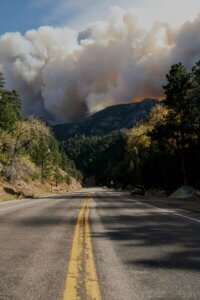
Consequences for humans
The material losses caused by forest fires can be considerable. Certain sectors, such as forestry, of course, but also tourism and agriculture, lose a significant proportion of their income. The costs of rehabilitating land and supporting displaced people, as well as fire-fighting, add to the bill.

In human terms, forest fires cause hundreds of deaths and thousands of injuries around the world every year. They can lead to the emergency evacuation of entire towns. Forest fires also have an impact on public health. The smoke and suspended particles released by fires can cause respiratory and cardiovascular problems, particularly in vulnerable people. These pollutants can spread over vast distances, affecting regions far from the source of the fire and compromising water quality.
III. Preventing and fighting fires
Although there are no miracle solutions, preventing and fighting forest fires requires a combination of approaches, such as vegetation management, education of the public and forest users, surveillance, and ground and aerial intervention.
Prevention
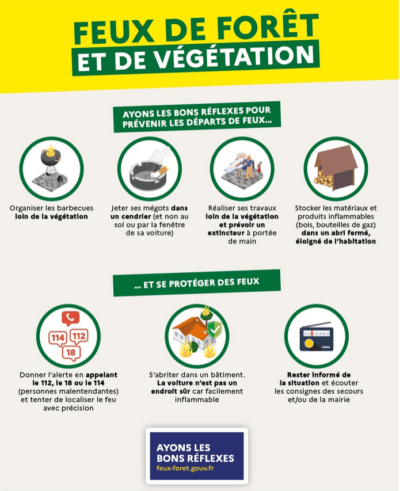
Forest fire prevention is based on a combination of actions, the two main aims of which are to reduce the risk of a fire starting and to slow its spread. The sooner we intervene after a fire has started, the more likely we are to extinguish it and limit the damage. Pruning trees, clearing undergrowth and creating firebreaks (areas cleared of trees and shrubs) are key preventive practices and facilities. Sometimes firefighters even carry out controlled burns, where small areas of vegetation are deliberately set alight to reduce the amount of flammable material. During particularly sensitive periods, the authorities may place restrictions on activities (e.g. banning fires and restricting access to forest areas).
In addition, fire lookout towers enable smoke from a fire to be spotted quickly. Drones, and to a lesser extent satellites, complete the surveillance system during periods of high risk. Since the majority of forest fires are caused by humans, it is essential to raise public awareness of good practices and reflexes to prevent the outbreak of accidental fires. Maps forecasting conditions favourable to the spread of fires enable the authorities to prepare appropriate responses. Forests are monitored using meteorological data from Météo-France. There are daily forest weather maps for fire risk, combining those published by the departmental prefectures and those of Météo-France). In particular, recommendations have been made in the reports of interministerial missions on forest fire prevention and control policy in the short and long term. In the Centre-Val de Loire region, there is also a regional forest fire atlas to identify the most fire-prone areas (see also the CNPF document on the issues in the CVL).
Fire management
Managing forest fires can be complex, depending on the context and various factors – such as the topography of the area, the size of the fire, its origin or the speed at which it is spreading. Fighting forest fires requires the quickest possible response, and intervention is therefore based on the predictive mobilisation of fire-fighting resources. The departmental fire and rescue services (SDIS) estimate the level of risk on a daily basis, which then determines the resources (human and material) and the level of surveillance put in place. The effectiveness of the fire response system depends mainly on early detection, so that the response can be coordinated effectively and specialist resources can be deployed quickly. This can be achieved by mobilising professionals and volunteers in the field. Technological innovations have also made it possible to set up early warning systems and fire forecasting models. In particular, airborne resources are playing an essential role in the strategy for attacking incipient fires through armed aerial surveillance (GAAR), which involves flying over high-risk areas to make airdrops on the beginnings of fires.
Drones are also beginning to be used to confirm the presence of a fire, to guide and supervise the actions of ground resources, to search for hot spots, to assess the volume and extent of the disaster and to produce 3D images.

Aeroplane and helicopter bombers are deployed to drop water and retardants on the most inaccessible areas, while on the ground forest firefighters intervene directly to contain and extinguish the fires. The most traditional method used by firefighters to fight fires on the ground is to extinguish them by spraying water or fire retardants. This phase can continue for several days after the fire has ended, as the fire can smoulder for a long time in the ground (particularly in peat bogs). Firebreaks can also be created (e.g. using bulldozers, cutting or tactical burning) to remove flammable debris and slow the spread of fires. Cooperation between the various services is essential to organise and optimise resources and effective intervention strategies. In the event of a major fire, international cooperation is often necessary.
Managing forests after fires
Forest management after a forest fire is a crucial step in restoring damaged ecosystems and preventing future fires. Forest restoration takes time and should not be rushed.
Initially, there will generally be a stage of damage assessment and restoration study, calling in experts to determine what is most appropriate to put in place. There may also be a phase of securing the forest, where it may be necessary to clear the area (e.g. of trees, debris, etc.) to prevent secondary fires, or to implement soil stabilisation measures to prevent erosion and landslides (e.g. installation of barriers).

Where forests are relatively resistant to fire (in the Mediterranean region), foresters usually allow the forest to regenerate naturally. Where regeneration is difficult or the forester wishes to favour other species, forest renewal is carried out by planting. In these cases, the issue of diversifying tree species arises, and foresters may choose species that are more resistant to fire or less flammable. Long-term monitoring is used to check whether the restoration has been a success or whether further action is required.